What a Croissant Taught Me About Home
LEARN MORE
It’s hard to conceive of a combination of ingredients more quintessentially Italian than tomato and basil. Pizza Margherita and Caprese salad are practically synonyms for Italy and, with the addition of the cheese that they both include, are culinary representations of the Italian flag. They are ubiquitous in Italian cuisine. They are, it would seem, as deeply rooted in the Italian story as Dante or the Roman Empire.
In reality, however, neither tomatoes nor basil are native to Italy. And the tomato, at least relative to Dante and the Roman Empire, is a fairly recent arrival. Tomatoes are native to the Andes, in the region that now covers Chile, Peru, and Ecuador, and were gradually brought north into what is now Mexico by native peoples during the first millennium A.D. (the English word tomato comes from the Aztec word for the fruit, tomatl). Tomatoes didn’t arrive in Europe until as recently as the 17th Century, when they were brought here by the Spanish.
It was the Spanish who introduced the tomato to Italy, very likely bringing it first to Naples, then a Spanish-controlled territory. And even then, it was mostly a curiosity, used more commonly as a garnish than as an ingredient; it wasn’t until as late as the 18th century that tomatoes began to be truly incorporated into the Neapolitan cuisine. And those early tomatoes were not the deep red tomatoes that are so emblematic of Italy today, but golden yellow ones, which were then called “pomo d’oro” (golden apples), leading to the contemporary Italian word for tomato, pomodoro.
I found myself thinking about all of this during a conversation I had a couple weeks ago with
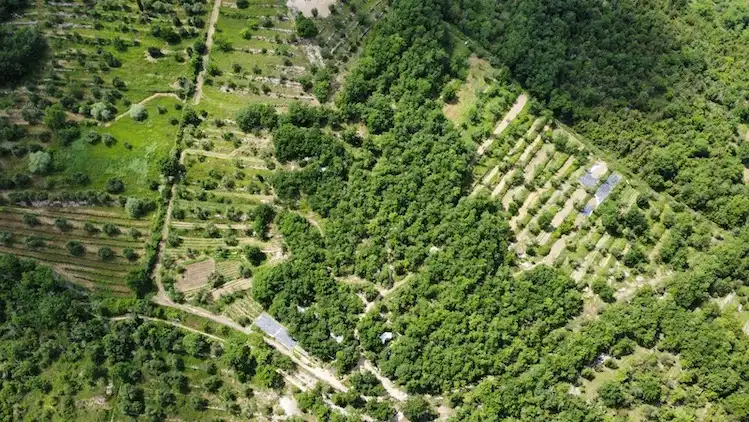
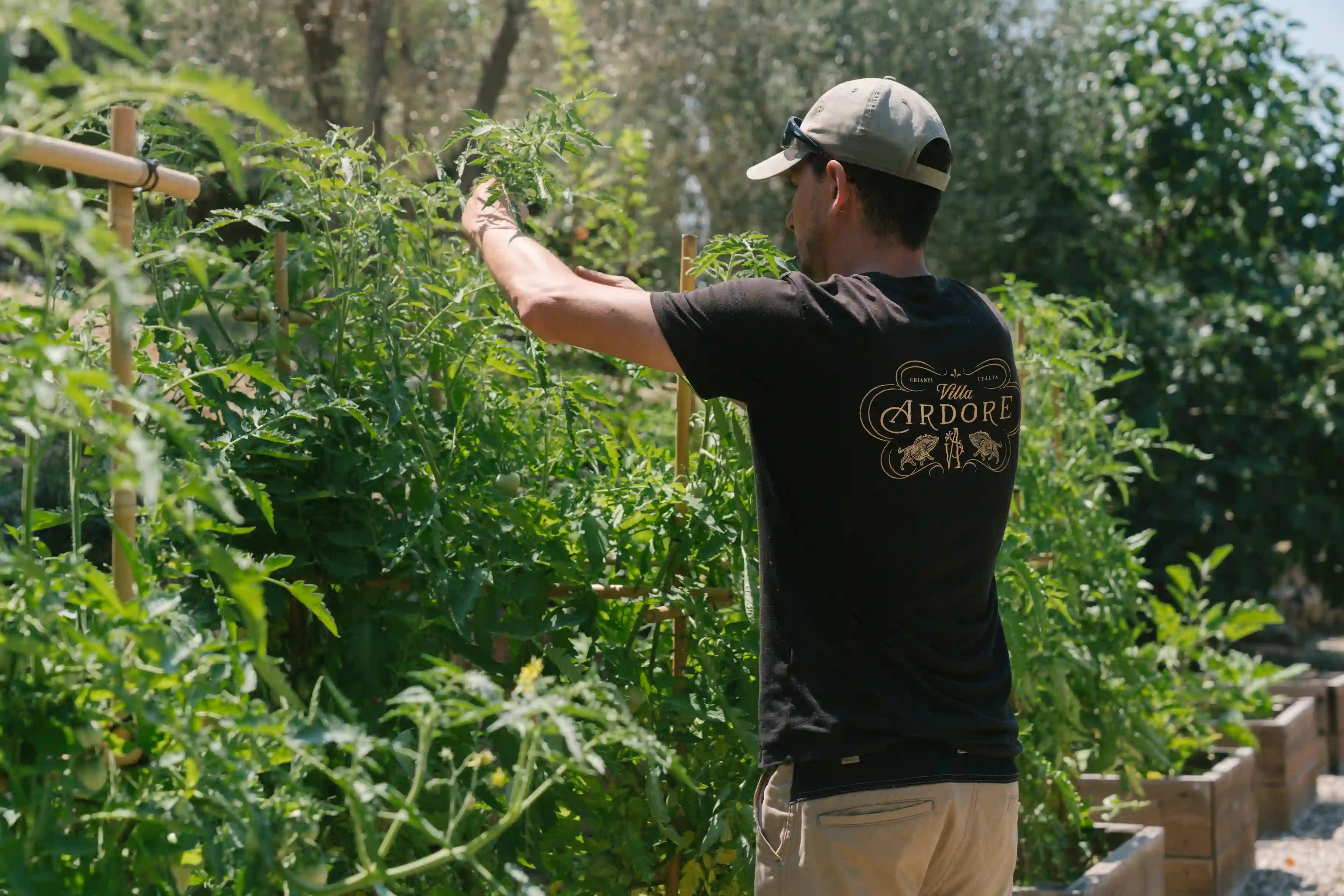
Lorenzo Costa, a fascinating young farmer who is transforming the culinary landscape around Gaiole-in-Chianti, about a half hour’s drive from Villa Ardore. Lorenzo, who had a successful career advising farmers on water use and conservation before becoming a farmer himself, is a walking encyclopedia of edible plants. As he walked me through his farm, he showed me plants that I had never heard of and never imagined existed, the most memorable of which was one whose leaves taste exactly like salt and, when dried and crushed into a powder, can be used as a substitute that has none of salt’s deleterious health effects.
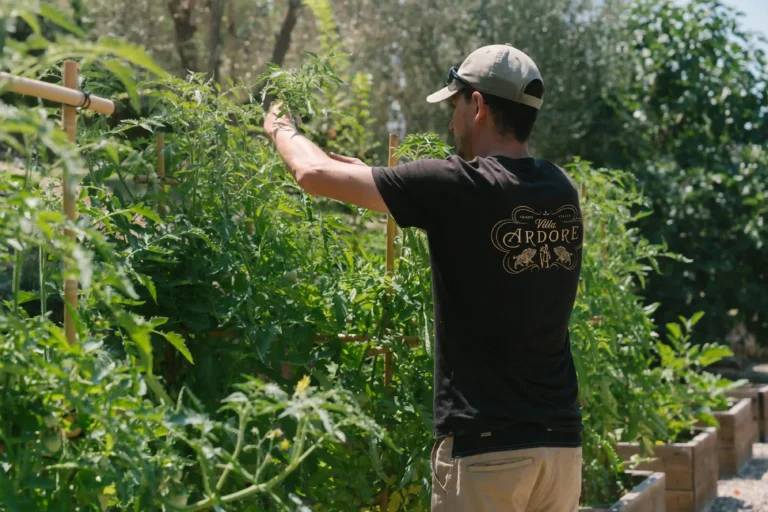
He also grows, always from seed, other delicious and nutrient-packed, albeit non-native, vegetables, such as a black spinach that is native to Peru, various root and leafy vegetables, and (this being modern-day Italy), no less than 18 varieties of cherry tomatoes. Many of these vegetables have never, historically, been grown here, either in Tuscany or elsewhere in Italy. They are interesting, often colorful and, I am told, always delicious. But my first thought was, “in this country, and especially in this specific part of the country, where tradition looms so large and there is such (justified) pride in continuing to do things as they have been done for generations, will people want what Lorenzo is growing?”
The answer would appear to be a resounding yes. Lorenzo’s fruits, and especially his vegetables, are some of the most flavor-packed that you will find anywhere. He sells them locally to the very best Michelin starred restaurants in the area, and chefs and customers alike have said that his vegetables are the best that they have ever tasted. Indeed, one elite chef designed an entire vegetable-only menu around Lorenzo’s produce.
It’s a remarkable achievement, considering that the earth throughout the area that includes Lorenzo’s farm seems so unpromising: rocky, with huge layers of limestone that over-calcifies the soil. While calcium is essential for crop-producing soil, a terrain that is too rich in calcium inhibits plant growth and does no favors for the taste of the fruits and vegetables that many of those plants produce. And much of the soil around Lorenzo’s farm is far too calcium rich to successfully grow produce of consistently high quality. So why is Lorenzo’s produce so bountiful, and so delicious?
The answer to this question is hinted at by the farm’s name: La Scoscesa (“The Steep One”). It exists on a long, steep hill—a hill that would be difficult to plant most crops on even if the soil weren’t so rocky. But centuries ago, the hills were terraced by medieval peasant farmers, creating long, flat surfaces from which they removed some of the rocks from the soil to create the dry-stone retaining walls that keep the terraces in place. This also allowed for better drainage, which reduces the soil’s calcium content to a more ideal level.
Eventually, the farm was abandoned by those who originally farmed it. Over much of the 20th Century and into the 21st, its terraces became overgrown, and some of its retaining walls began to crumble. But this sad process was arrested and has begun to be reversed since Lorenzo bought the farm a few years ago and has begun the long, slow, and labor-intensive process of returning it to its agrarian roots. So, while much of the produce that he grows is new to the region, his method of growing it is steeped in a tradition that had become all but lost.
Bearing in mind Italy’s history with the tomato, maybe Lorenzo’s introduction of new vegetables that thrive in the local climate and soil is also a return to tradition. I think that it is: a tradition that respects the past not in a way that preserves this culture or place like a fly in amber, but that builds on it to enrich our lives today and into the future, much as the Neapolitans did for us with the humble but remarkable tomato.
My visit to La Scoscesa and rich conversation with Lorenzo Costa also made me think about something that would seem to be a world apart from what he and I discussed, but is in reality closely connected with it: a new line of bath products being produced exclusively for our guests beginning in winter 2027. It’s a project that Christian and I, as well as villa manager Francesco Goracci, have put a great deal of thought and effort into achieving over much of the past two years, and we have naturally been happy finally to have met that goal. But satisfaction at having achieved a long-sought goal doesn’t by itself explain why that satisfaction has been so deeply emotional. Thanks to my visit to La Scoscesa, I think I finally understand why.
It’s because, like the exceptional produce that Lorenzo creates, our new bath products are the product of a mind that honors tradition, feels awe at what nature has provided, and sees how much more tradition applied to nature can bring forth. And, like Lorenzo’s creations, the story of our bath products begins on a local farm here in the Tuscan hills. This farm is the home of the boutique bath product and cosmetic agency Èssenziale.
The driving force behind Èssenziale is its founder and owner, Claudio Gori. We were drawn to this small, local company, as we were to Lorenzo Costa’s Scoscesa, by the compelling passion that lies behind everything that Claudio and his team do. Every essential ingredient used in their products is grown locally, most of it being grown on Claudio’s own farm, just down the hill from the nearby town of San Donato in Poggio. Claudio will not use any plant in his product that is not naturally grown and harvested locally. At the same time, he eschews products, like lavender soap, that at this point feel like cliches. Instead, he blends botanical ingredients—yes, including lavender in some of his current products—for their efficacy as well as their scent to create products that meet or surpass the quality of those produced by some of the most well-known high-end companies.
But as much as Claudio has a clear vision, and a drive to strictly adhere to the principles on which he founded his company, our collaboration with him has been just that—a collaboration.
The germ of that collaboration was a casual conversation over coffee after I had been to Claudio’s former shop in San Donato’s historic center a few times and struck up a casual acquaintanceship with him. We discovered that we had a few friends in common, and he very kindly offered to help me with a bureaucratic problem I was having that one of our mutual friends told him about. This led to us getting to know each other better and discovering that we—he at Èssenziale and we at Villa Ardore—share not only a love for this beautiful place that we are privileged to live in, but a desire to both preserve it and share it with others.
We first began our discussions about the creation of Villa Ardore bath products early this past winter, describing for him what we were looking for: products that evoke Villa Ardore’s essence—its grounds, with its rich landscaping, and the feeling of being there; something with a natural scent that is neither too flowery, which lavender can be, nor too medicinal, which both rosemary and cypress can be.
We went through several iterations, each time getting closer and closer to what we were looking for. I won’t tax your patience by describing them all, except to say that we not only scent tested each, but also had each product in the line of every iteration used by some of the most demanding critics of this kind of product we know, including our marketing manager, Hanna, and Christian’s cousin, Angela. And then, late this spring, we finally found exactly what we were looking for.
We think that Claudio is as proud of these new products as we are, and we can’t wait to introduce them as a standard part of the Villa Ardore guest experience. We look forward also to a deepening collaboration with Lorenzo Costa. The opportunity to work with our talented neighbors, like Lorenzo and Claudio, who share our passion for this beautiful part of Tuscany, and who share our desire to bring it to others, is one of the many things that make us so grateful to be a part of this community, and to have the privilege of doing work that we love so deeply.


Another of the many things that we love about Tuscan life is the degree to which so much of it ebbs and flows in harmony with the seasons. Nowhere is this more evident than at the table. One could almost be beamed into the average Tuscan household at dinnertime, see nothing but the food on the table, and know not only the season, but also the specific month.
We are now in June, and the dead giveaway is the proliferation in markets everywhere of the first, early zucchini—smallish, a still somewhat pale shade of speckled green, and topped with its beautiful, almost flame-like flower. The vegetable itself is of course delicious, versatile, and much eaten throughout the summer. But during this brief, sweet period of June, when the schoolyear has newly ended and summer’s freedom, with holidays at the seaside and weekends grilling in the backyard at home, seems to stretch out endlessly before us, it is the zucchini’s delicate flower that is the star of the show.
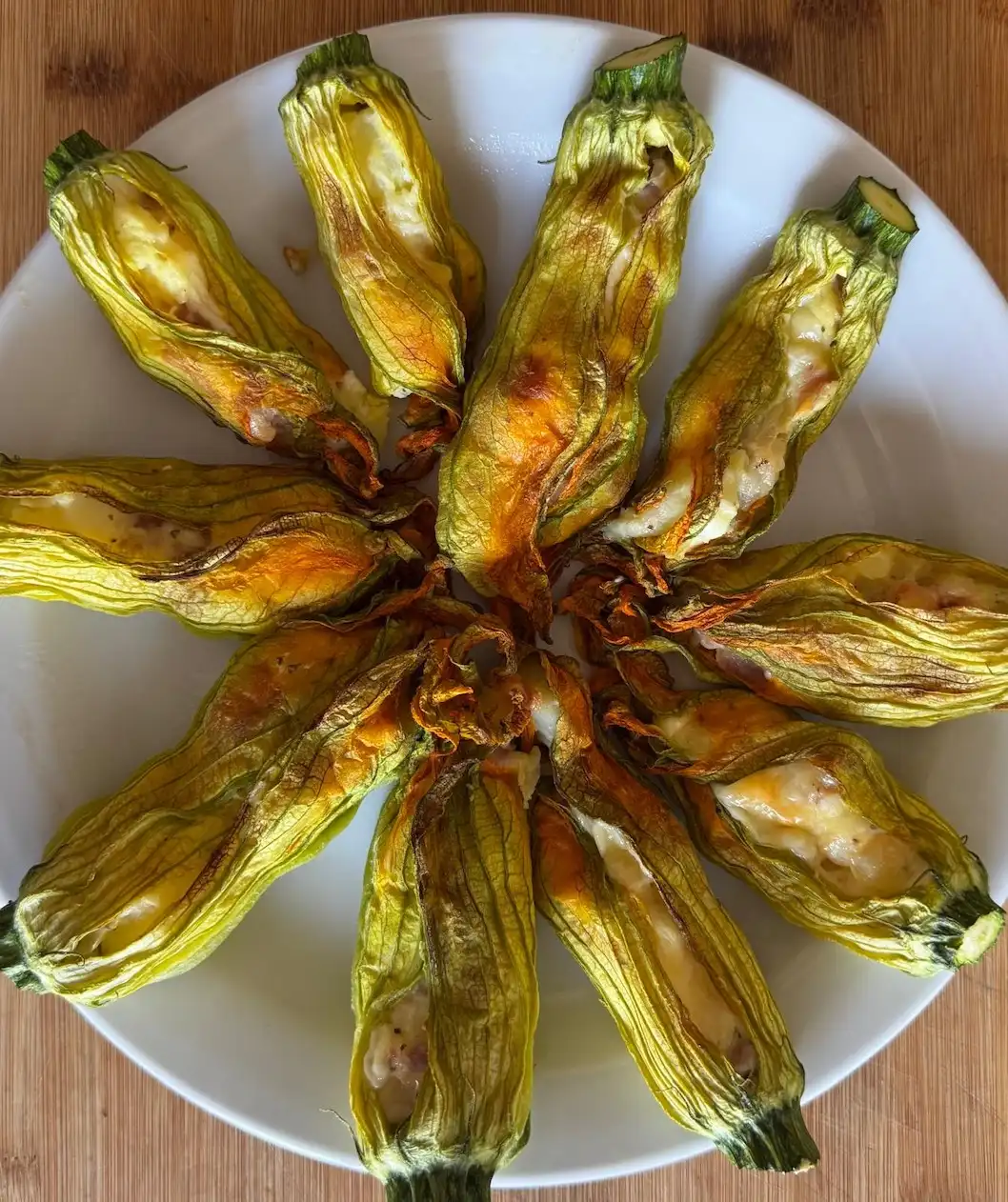
The flower has many uses; it can be pulled apart and tossed into a salad, used in various frittate, or even deep fried with a light, melt-in-your-mouth coating and stuffed with goat cheese, as they prepare it in Taverna Squarchialupi, one of the many wonderful restaurants in nearby Castellina-in-Chianti. But our preferred method is to stuff and bake them, for a flavorful but light lunch, appetizer, or side dish.
This recipe is quick and relatively easy to make. I say “relatively” only because it requires some patience to open the flower so that it can be stuffed. This is because the yellow and orange tips of the flower have a very slight stickiness to them, which causes the flower to close and, when opening it, one must be careful not to rip the flower entirely apart. The easiest method is to begin at the flower’s base, where it is still connected with a small piece of the very top of the zucchini, and where the interior of the flower remains open like a partially inflated balloon. Gently pull the sides of the flower away from each other without tearing it open, and work your way to the top. When you get to the top, you can at that point make a long, straight tear down to the base, which will allow you to easily remove the stamen and pistil, which have a bitter flavor, from the bottom of the flower before stuffing.
Ingredients:
10 zucchini flowers (choose zucchinis with the largest flowers that you can find. Cut the flower from the larger part of the zucchini, but keep it attached to the stem, which is edible and is necessary for the flower to hold together when you stuff it)
1 medium-size potato
A scant 3 oz. (80 g) prosciutto crudo, chopped into small pieces
5-¼ oz. (150 g) scamorza cheese (if you can’t find scamorza, provolone is a good substitute), chopped into small pieces of ¼ to ½ inch. Tablespoon of freshly grated parmesan cheese
1 egg
A scant half teaspoon of dried marjoram
Salt and pepper to taste (note: due to the prosciutto and cheeses, most will likely find that added salt is unnecessary)
Method:


This site is protected by reCAPTCHA and as such,
is subject to Google’s
Terms of Service and
Privacy Policy.
By subscribing, you agree with our Privacy Policy